Friday, November 21, 2025
|
|
This newsletter highlights the latest information on IMF activities, analytical work, and policy analyses on the Caucasus and Central Asia (CCA) region.
Enjoy reading, and do not forget to subscribe!
For the Russian version, please click here.
|
|
Resilient and Ready: Highlights from the Regional Economic Outlook Launch in Almaty

The IMF’s latest Regional Economic Outlook (REO) for the Middle East and Central Asia was presented in Almaty, Kazakhstan, on October 29 and 30. The agenda kicked off with an interactive session at the Kazakh British Technical University, where students and faculty joined the Director of the Middle East and Central Asia Department (MCD), Jihad Azour, for a lively discussion on the region’s resilience and outlook amid global uncertainty.
Key takeaways included: GDP growth is projected at 5½ percent in 2025, moderating to 4 percent thereafter; inflation is expected to ease as fiscal consolidation advances; and risks remain from geopolitics, sanctions, and commodity price swings. The conversation also highlighted the region’s progress in AI adoption, digital infrastructure, and human capital development—supported by new government initiatives.
Day two featured a high-level policy dialogue at the Caucasus, Central Asia, and Mongolia Regional Capacity Development Center (CCAMTAC). Discussions underscored strong growth supported by domestic demand, remittances, and energy exports, with Kazakhstan leading the region. Panelists emphasized the need for continued structural reforms to foster private sector development, economic diversification, and deeper regional integration to sustain momentum. Despite global headwinds and inflationary pressures, the CCA region stands out for its economic resilience and commitment to long-term prosperity.
You can watch the full panel here.
After Almaty, the IMF team brought the REO’s key messages to Baku and Tbilisi, engaging with policymakers, private sector leaders, and academics. In Baku, discussions centered on navigating uncertainty, oil price risks, implications of US tariffs and a weaker dollar, and sustaining the growth momentum. In Tbilisi, students also voiced concerns about whether recent economic gains have been broadly shared across society.
Read more about the key messages and takeaways for the CCA region here.
|
|
Policymakers Push for Growth and Integration at Annual Meetings Roundtable
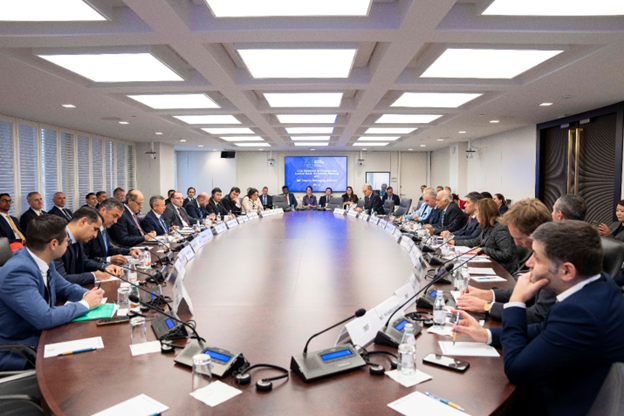
Ministers and central bank governors from the region met during the IMF-World Bank Annual Meetings for a high-level roundtable chaired by IMF Deputy Managing Director Bo Li, with remarks from MCD Director Jihad Azour and MCD Deputy Director Subir Lall. Discussions focused on how the region can sustain growth and build on recent momentum toward deeper regional integration amid global uncertainty. Participants highlighted the region’s resilience, with growth holding firm despite global challenges, and emphasized that continued reforms and stronger cooperation are essential for long-term prosperity. They also showcased concrete progress on integration:
- Armenian officials pointed to the progress on the peace agreement with Azerbaijan as a gateway to greater connectivity;
- the Kyrgyz Republic delegation highlighted advances in digital and financial links, including cross-border QR payments;
- Kazakhstan’s representatives emphasized the expansion of trade and transport corridors; and
- Georgia’s noted major investments in logistics and digital infrastructure under the Middle Corridor initiative.
Ongoing IMF research shows that closing policy and infrastructure gaps could deliver significant benefits if reforms strengthen governance, macroeconomic credibility, and human capital. Participants agreed on the need to harmonize regulations, advance digital systems, and mobilize financing for green and inclusive growth. The IMF reaffirmed its commitment to support the region’s efforts through policy advice, capacity development, and financing.
|
|
From Law to Practice: How Central Bank Independence Keeps Inflation in Check
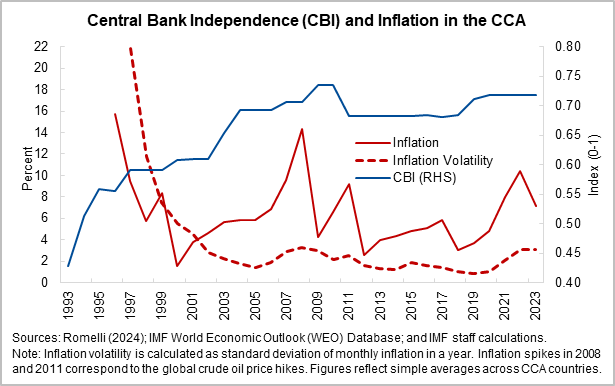
As fiscal pressures mount, central bank independence is back in the spotlight. Since the 1990s, CCA central banks have built strong legal independence, helping to tame inflation and reduce volatility. Yet, in practice, challenges remain.
A forthcoming IMF departmental paper led by Dmitry Gershenson, Deputy Division Chief in MCD, underscores an important finding: the more independent a central bank, the lower the inflation—and this link only strengthens over time. But legal safeguards alone are not enough. To translate independence on paper to independence in practice, CCA economies must strengthen financial autonomy, ensure the personal independence of central bank officials, and enhance transparency. The message is clear: credibility counts, and independence delivers.
Stay tuned for the forthcoming paper for deeper insights.
|
|
IMF Reaches Staff-Level Agreement on a New Program with Armenia
On October 16, the IMF and Armenian authorities reached a staff-level agreement on the sixth review under the current Stand-By Arrangement (SBA) as well as on policies under a new three-year SBA. This follows the 2025 Article IV consultation and program negotiation mission led by Alexander Tieman, Mission Chief for Armenia at the IMF, in Yerevan in September.
Armenia’s economy remains resilient, with real GDP growth averaging 8.9 percent over the past three years, driven in part by inflows of foreign exchange, migrants, and businesses from Russia. Growth is expected to remain solid at 5–5½ percent in 2025–26. Inflation is easing toward the central bank target, and the banking sector remains highly profitable, well capitalized, and liquid. Fiscal consolidation is underway: the 2026 budget aims to preserve macro-stability and support priority spending, including on social protection, infrastructure, and security.
Going forward, the government’s structural reform agenda appropriately focuses on boosting labor force participation, diversifying exports, and improving the business environment. Success will hinge on timely and effective implementation of the authorities’ employment and export strategies, strengthening the insolvency framework, and advancing governance reforms.
The IMF Executive Board is expected to consider the review on December 1, with the staff report to follow shortly thereafter.
|
|
Chart of the Issue: Growth Builds Momentum, Reforms Hold the Key
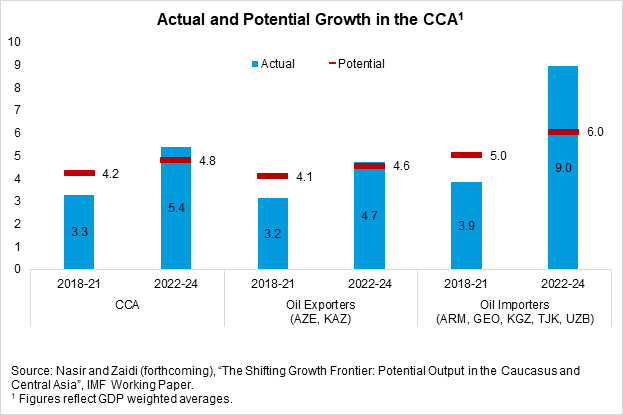
The CCA region’s potential growth has improved since 2022, driven by post-pandemic recovery and structural shifts following the outbreak of the war in Ukraine, including the reallocation of labor and capital toward more productive service sectors. The upswing has been more pronounced among oil importers, supported by strong remittance inflows and productivity gains, while oil exporters have seen more modest gains, reflecting slower progress on economic diversification.
To maintain this momentum, the region will need to deepen financial systems and advance structural reforms that foster private sector development and strengthen economic resilience.
|
|
CCAMTAC Welcomes New Director, Showcases Regional Impact
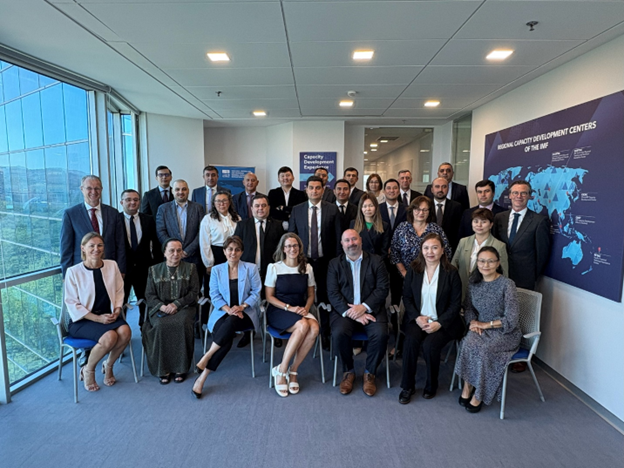
Regional Roundtable: Implementation of Updated Macroeconomic Statistical Standards (August 25–27)
The IMF is delighted to announce that Holger Floerkemeier will take the helm as CCAMTAC Director on December 1, succeeding Norbert Funke. Norbert’s leadership steered CCAMTAC through its formative years with ambition and purpose, laying the groundwork for lasting impact across the region. Holger is well-positioned to guide CCAMTAC into its next chapter, as he brings extensive experience: he previously led the IMF’s Middle East Regional Technical Assistance Center (METAC) in Beirut, served as Deputy Director at the Joint Vienna Institute (JVI), and headed the Regional Technical Assistance Center (RTAC) team at the IMF’s Institute for Capacity Development.
An independent external evaluation confirmed CCAMTAC’s strong regional impact since its launch and offered valuable insights for shaping CCAMTAC’s Phase II program, set to begin in 2027. Recent highlights include a high-level roundtable on “Implementation of Updated Macroeconomic Statistical Standards” in August, where participants explored an implementation playbook to align with the latest statistical standards for balance of payments (BPM7) and national accounts (2025 SNA). In September, CCAMTAC also published a regional note on Government Finance Statistics, taking stock of achievements and outlining priorities for the future.
For more information on CCAMTAC and its initiatives, please visit the CCAMTAC website or follow on LinkedIn.
|
|
|
The IMF’s Caucasus, Central Asia, and Mongolia Regional Capacity Development Center (CCAMTAC) is a collaborative initiative launched in 2021. It aims to strengthen economic policies and institutions by providing technical assistance and training to its member countries of Armenia, Azerbaijan, Georgia, Kazakhstan, Kyrgyz Republic, Tajikistan, Turkmenistan, Uzbekistan and Mongolia.
|
|
|