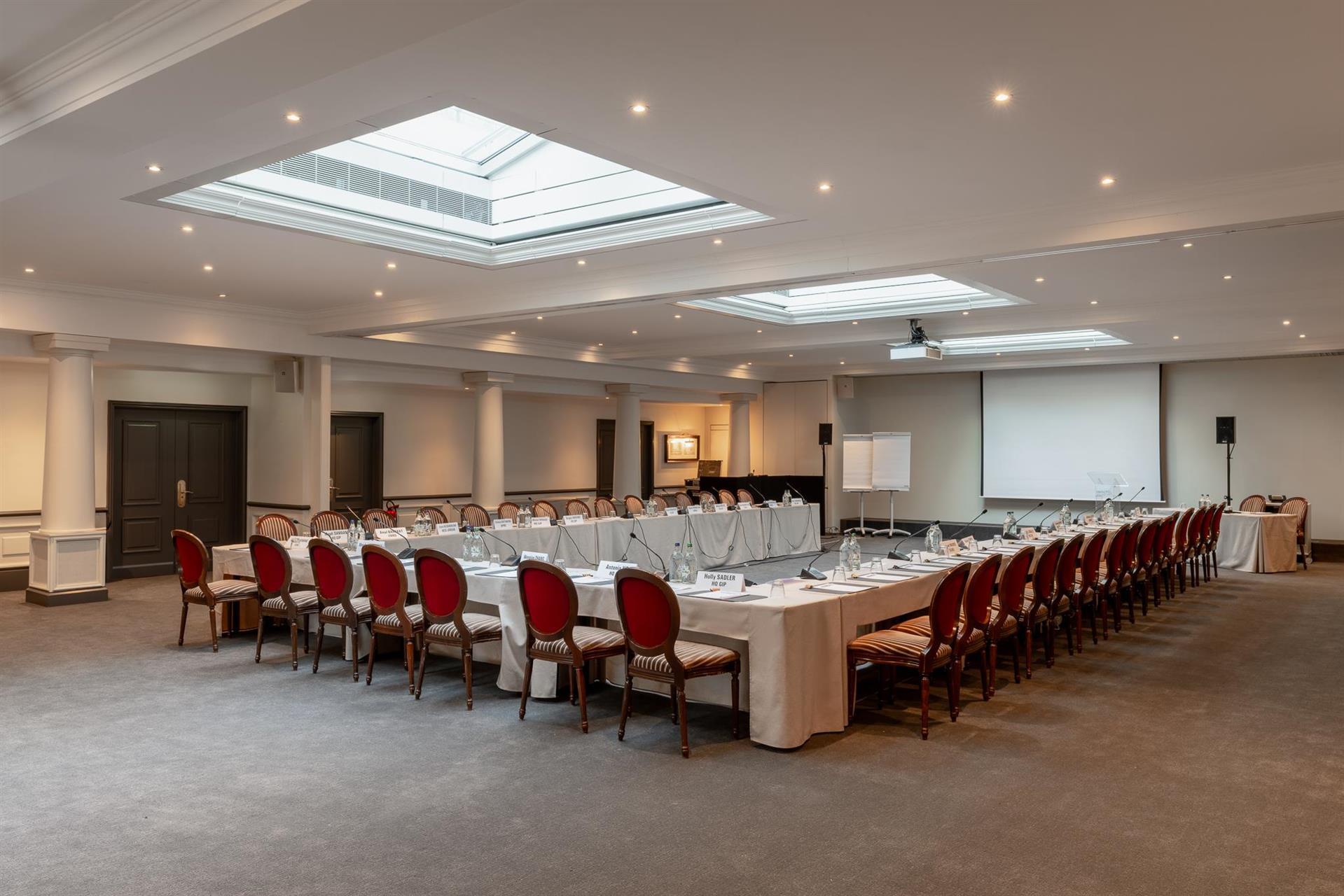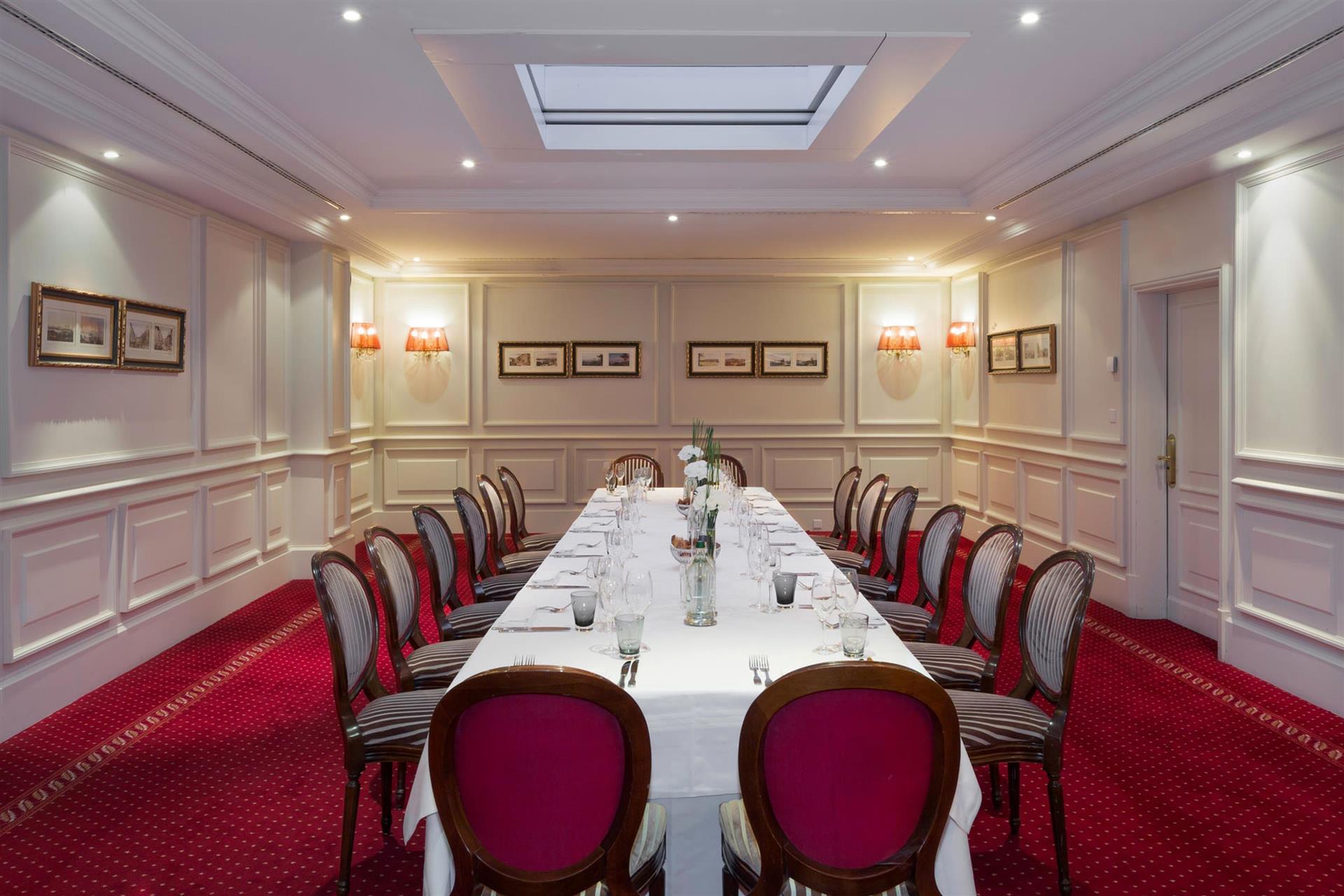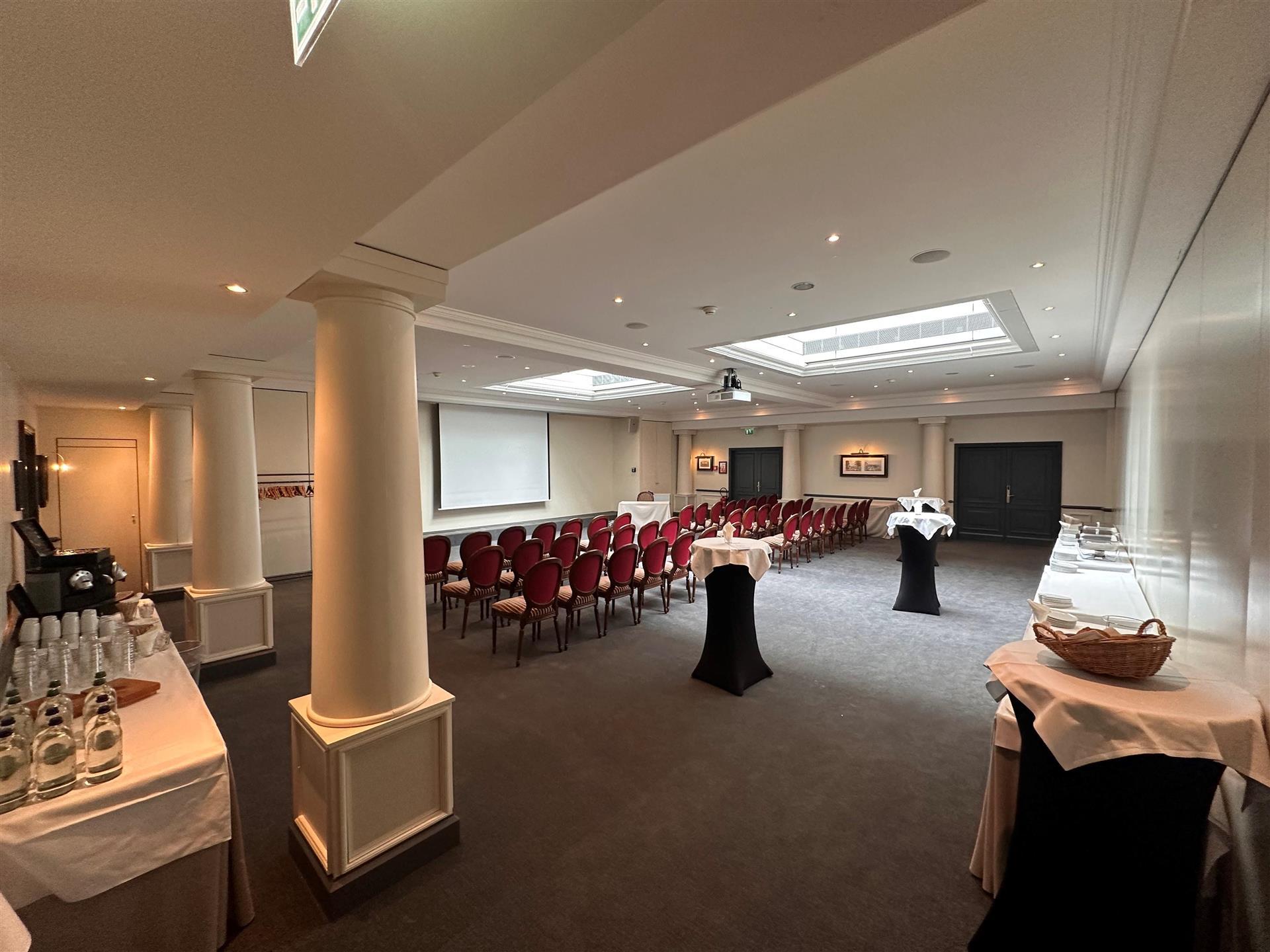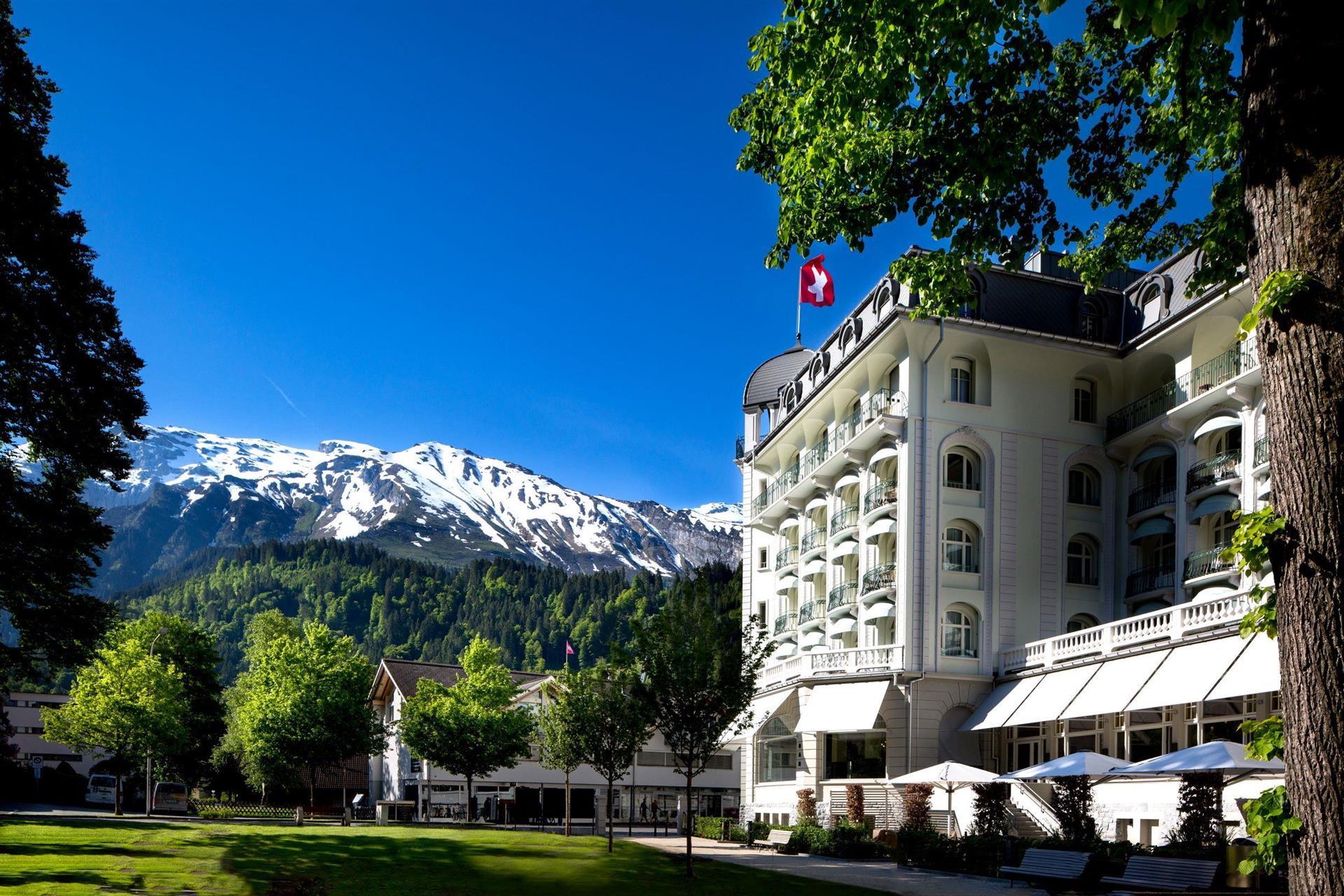

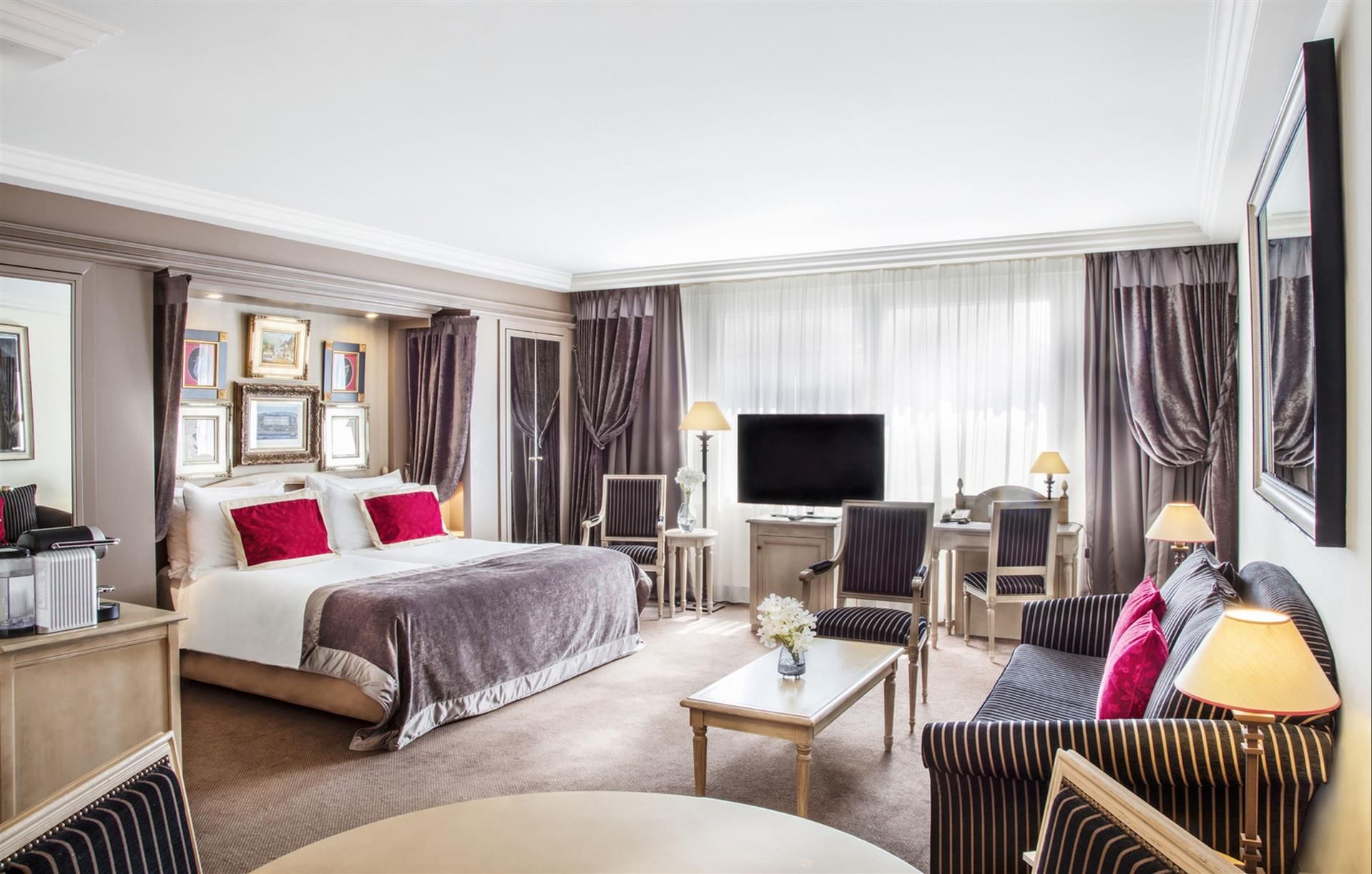

Enter the elegant world of the Hotel Royal Geneva. Inspired by neoclassical architecture, it offers well-furnished, comfortable, and connected spaces. Here, it’s all about tradition, attention to detail, and cosy surroundings.
The hotel has 202 rooms including standard, superior, executive rooms, junior suites and suites. Hotel architect Paul Sartre’s describes the rooms as being like stylish homes, with their neoclassical furniture, their woodwork, drapes, paintings, and curios. They radiate wellbeing and comfort.
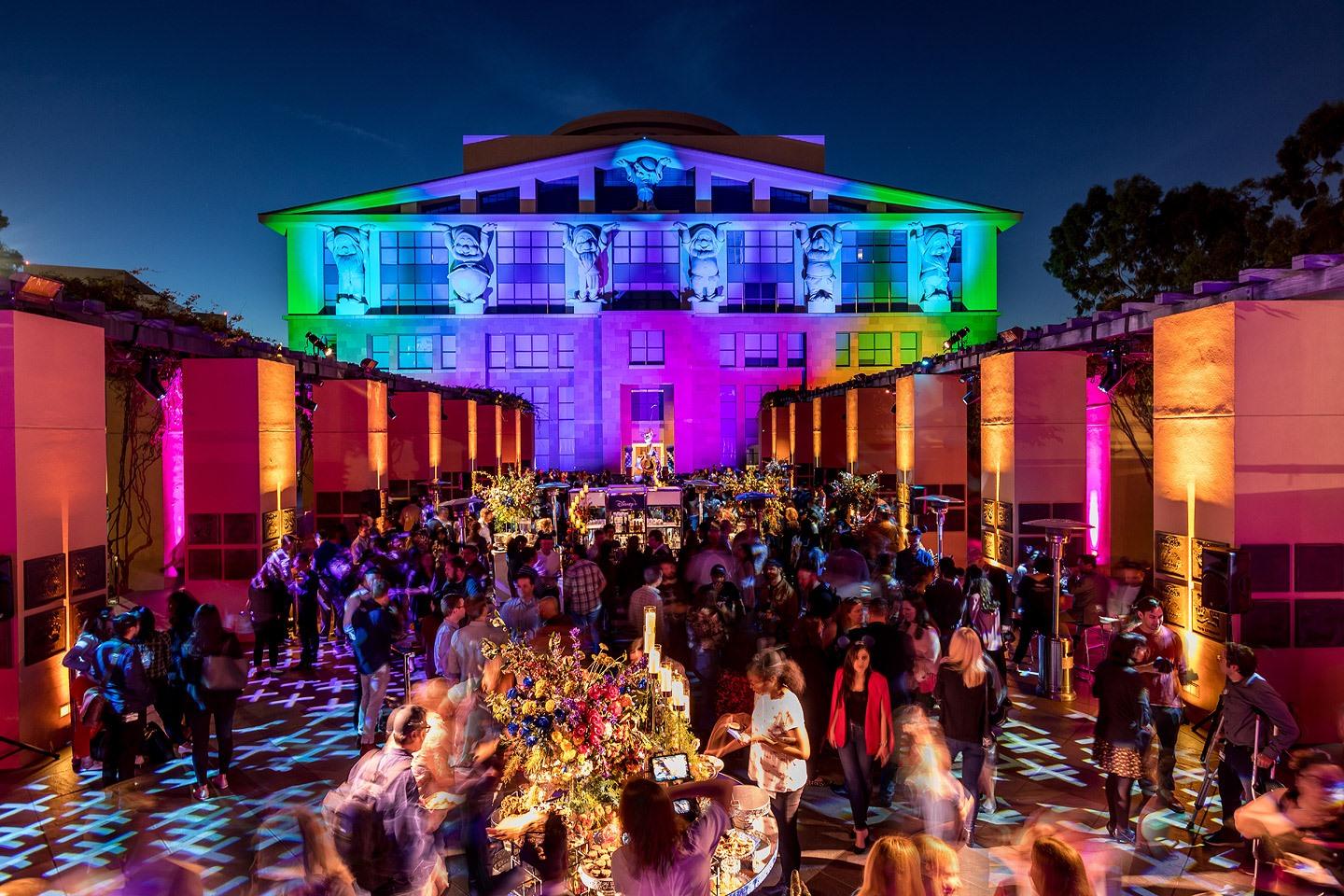
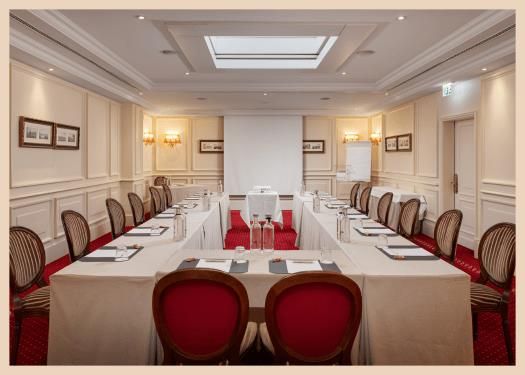
Why not organize a distinctive event in the Hotel Royal Geneva's neoclassical setting. With its dedicated teams, state-of-the-art technology, and real sense of hospitality, your event is sure to be a resounding success. Your banquet will also gain an added touch of class with Chef Armel Bedouet’s varied seasonal cuisine.
개최지 세부사항
체인Independent / Other
브랜드Other Affiliation
완공 연도1968
개보수 연도2024
회의 공간 합계10,742 평방 피트
객실202
개최지 유형호텔
업계 등급
Hotelleriesuisse
수상
Industry awards
4 Star Superior
편의 시설
객실 기능 및 손님 서비스
가방 보관소
룸서비스
세탁 서비스
인터넷 액세스
컨시어지 서비스
시설
공간 (전용)
공간 (준전용)
애완동물 가능
장기 투숙
현장 캐더링
현장의 식당
휠체어 사용 가능
비지니스 서비스
VIP 서비스
동영상 컨퍼런스
시청각 기능
업무 센터
레크리에이션 활동
수상 스포츠
스키
헬스클럽
교통편
공항 셔틀
기차
버스
택시
장비
이동용 벽
피아노
객실 기능 및 손님 서비스
가방 보관소
룸서비스
세탁 서비스
인터넷 액세스
컨시어지 서비스
시설
공간 (전용)
공간 (준전용)
애완동물 가능
장기 투숙
현장 캐더링
현장의 식당
휠체어 사용 가능
비지니스 서비스
VIP 서비스
동영상 컨퍼런스
시청각 기능
업무 센터
비수기
이벤트 개최 시 개최지가 선호하는 우선순위 창
2026년 1월 16일 - 2026년 3월 8일
2026년 7월 6일 - 2026년 8월 30일
2026년 1월 16일 - 2026년 3월 8일
2026년 7월 6일 - 2026년 8월 30일
2026년 1월 16일 - 2026년 3월 8일
2026년 7월 6일 - 2026년 8월 30일
2026년 1월 16일 - 2026년 3월 8일
2026년 7월 6일 - 2026년 8월 30일
Seasonal Availability
Do you want to know if your event is during the high or low season? Check the season availability for this hotel.
Genève-Cornavin railway station is Geneva's main train station, located in the centre of the city.
The station has over 400 train departures every day from its eight through-platforms. Platforms 7 and 8 have French and Swiss border controls. Long distance and regional express trains leave for France without making any stops in Switzerland.
The Hotel Royal is 300 meters away from the train station
Geneva Airport is the international airport of Geneva, the second most populous city in Switzerland.
It is located 4 km (2.5 mi) from the city centre. It surpassed the 15 million passengers mark for the first time in December 2014. The airport serves as a hub for Swiss International Air Lines and easyJet Switzerland.
It features a route network of flights mainly to European metropolitan and leisure destinations as well as some long-haul routes to North America, China and the Middle East.
Art from Antiquity, Africa, Asia and Oceania.
Culture and tribal art of the world’s civilizations are part of this amazing collection.
Situated in the heart of the Old Town, the Barbier-Müller Museum preserves, exhibits and studies a collection started in 1907. Today the collection contains several thousand artworks from tribal and classical Antiquity as well as sculptures, fabrics and ornaments from around the world. Many of these items are priceless masterpieces. These “historic” items cannot be found anywhere else today, which makes this private collection the most important of its kind in the world.
An encyclopaedia of cultures from the prehistoric to contemporary periods.
Multidisciplinary in its approach, Geneva's Museum of Art and History invites visitors to travel back in time, and to cover all the important stages in the history of Western civilization.
Inaugurated in 1910, the Musée d’Art et d’Histoire is one of the three largest museums in Switzerland and the only one with such a wide range of collections, the result of the merging of several regional museums and donations from collectors, foundations and philanthropic citizens. The richness of its collections is further enhanced by the presence of major works and several unique series, making it an institution of international standing.
Scale the heights!
At the highest point of the Old Town, its towers offer a breathtaking panorama. And its vaults house the largest archaeological site north of the Alps.
St Peter's Cathedral, built in the 12th century, underwent important transformations in the 16th century. The first walls were constructed around 1160 and work continued for almost a century. In 1535 at the time of the Reformation, the Cathedral became a place of Protestant worship. Visitors undaunted by climbing the 157 steps of the north tower are rewarded with an incredible view of the city and the lake. Don't forget to visit the archaeological site below the Cathedral and admire its treasures dating back to Antiquity.
The lakeshore’s star attraction is the elegant water fountain, dazzling visitors as it shoots 140 metres into the sky.
Originally a simple security valve at the Coulouvrenière hydraulic factory, the Jet d'Eau has become the landmark of Geneva. Its millions of air bubbles will immediately put you under its spell.
The fountain came into being by chance. In 1886, a hydraulic power station was built to deliver water under pressure from the Rhône to the city’s fountains, households and factories. One evening, pressure build-ups forced the engineers to install a special pressure relief valve. This marked the birth of the Jet d’Eau. The ephemeral work of art soon became a tourist attraction and was moved closer to the lakeside. With time, water column grew taller. Since 1951, an autonomous pumping station has propelled 500 litres of water per second to a height of 140 metres at a speed of 200 km/h (124 mph)
Leaning against the city’s ancient fortifications, the Reformation Wall keeps watch over the Parc des Bastions.
A stone’s throw from the Place de Neuve in an exceptionally beautiful park, Europe’s most important Protestant reformers are honoured with giant statues and bas-reliefs.
The Reformation Wall in the Parc des Bastions is an imposing monument. The major reformers are portrayed with giant statues and bas-reliefs. In the middle stand Jean Calvin, Guillaume Farel, Théodore de Bèze and John Knox. On the sides we find those who carried the Reformation across Europe. Geneva’s maxim ‘Post Tenebras Lux’ (light after darkness) is engraved into the wall because it also became the motto of the Reformation movement. At the park’s entrance lies the Place de Neuve with its buildings dedicated to art and culture.
A village in the city.
Carouge, this ancient market town that formerly belonged to the kingdom of Sardinia, lives a Genevan version of “la dolce vita”. Its streets lined with boutiques, food shops and workshops exude a Bohemian atmosphere. Visitors appreciate the lively ambience on its leafy squares.
Carouge, across the River Arve, is the Greenwich Village of Geneva. You can spend hours strolling along the streets and window shopping in its galleries and boutiques. The Mediterranean architecture reflects its Sardinian origins, giving it this air of the South. Spend a relaxing few hours on its shaded terraces in the company of residents, craftsmen, antique dealers or artists. Or an evening with Geneva’s smart set in a trendy bar!
A universal symbol of research, knowledge and innovation.
The Globe of Science and Innovation symbolises CERN’s message to society in the fields of science, particle physics and cutting-edge technologies, and their applications in everyday life.
The Globe of Science and Innovation is a landmark for CERN and a symbol of sustainable development for all. It is 27 metres high and 40 metres in diameter, which is about the size of the St. Peter's Basilica's dome in Rome! A unique visual landmark by day and by night, the Globe of Science and Innovation is a metaphor for Planet Earth. On the ground floor , the ‘Universe of Particles’ exhibition takes the visitor on a journey deep into the world of particles and back to the Big Bang.
The symbol of International Geneva.
The Palais des Nations, built between 1929 and 1936, is the European headquarters of the United Nations. This centre of world diplomacy welcomes more than 25,000 delegates every year. A great number of artworks are displayed in its rooms. The building can be visited every day.
Geneva originally built the Palais des Nations for the League of Nations founded in 1919. After the second World War and the dissolution of the League, the building was ready to welcome the European seat of the newly constituted United Nations (UNO). It is the second largest UN centre, the first being the headquarters in New York, and as large as the Versailles Palace. Amongst the many works of art, the most amazing is probably the ceiling of the ‘Human Rights and Alliance for Civilisation Room’ painted by the artist Miquel Barcelò and donated by the Spanish government.
Geneva's lovely Botanical Gardens is must visit place for families with kids or anyone who needs to rest his busy mind and enjoy the tranqulity of beautiful nature, while not leaving Geneva.
The garden is home to over 16,000 different species of plants (rockery, medicinal, horticultural…), trees and shrubs blooming at different seasons to ensure the all-year round feast for the eyes. This large catalogue of greenery is spread out through different sectors such as the Greenhouses, Rockery, Arboretum and Winter Garden. If you would only have time for one of those, we strongly recommend the Winter Garden, built in 1913 and moved to its current location in 1935, it beholds a wide variety of tropical plants and fruits. The greenhouses of Pregny, once owned by the Baron Rotschild, is another true treasure of green abundance and diversity.
The Bains District is an avant-gardiste European platform for contemporary art.
With the opening of the Museum for Contemporary Art (MAMCO) in 1994, the whole district underwent a transformation and is today renowned for its cultural activities and night-life. Don’t miss the Nuit des Bains.
The Bains District is a true laboratory for contemporary art. In the heart of the city and the immediate vicinity of the MAMCO, a throng of galleries organises specific and targeted exhibitions. Trendy bistros contribute to this cultural and late-night frenzy. Three times a year the whole area celebrates the event 'La nuit des Bains' and all the galleries open simultaneously for private viewings.
The benchmark on the modern art scene.
Connoisseurs and those new to contemporary art know that visiting the Mamco is mandatory when in Geneva. This museum has made an entire district of Geneva a European hub of modern art.
The Mamco is the largest and youngest museum of contemporary art in Switzerland. It is internationally renowned as a reference on the contemporary art scene, based on a collection of 4,000 items, a third of which is owned by the museum. Since opening in 1994, the Museum has held over 450 exhibitions, reflecting the diversity and dynamism of the Swiss and international art scene. Three times a year, the Mamco adds a new feature to its permanent exhibition. The programme is divided into two three-year sequences.
The humanitarian adventure
Emotion, discovery, reflection: the Museum offers you a unique opportunity to enter into the history of humanitarian action.
Three separate areas, each developed by a well-known exhibition architect, allow you to explore three major challenges in today’s world: Defending human dignity, Restoring family links, Reducing natural risks.
An interactive chronology unfurls 150 years of humanitarian history, while Current focus enables you to track Red Cross and Red Crescent operations right around the globe.
Excellence in the field of horology.
Experience a journey through five centuries of watchmaking.
The Patek Philippe Museum is located in the heart of the Plainpalais district. Set up in 2001, it showcases the most prestigious creations of the brand’s master watchmakers. Visitors can also admire an extraordinary collection of watches, musical automata and enamel miniatures from the 16th to the 19th centuries, created in Geneva, Switzerland and Europe. The museum also houses a library entirely dedicated to horology and its related subjects.
Geneva’s often imitated but never equalled Flower Clock is a renewable living masterpiece.
It lies a few steps away from the lake and is one of Switzerland’s most photographed sites. The clock features the world’s longest seconds-hand.
The clock, situated at a corner of the Jardin Anglais, was created for the first time in 1955 and contains about 6,500 flowers and plants. The floral arrangements change according to the season. The flower clock is not only pretty, it also tells the time with Swiss precision - the time you see is transmitted by satellite. Another important detail - the seconds-hand is 2.5 metres long, the world’s longest!
Quai du Général Guisan
Genève, CH
Looking for more vendor options?
호텔, 레스토랑, 개최지, 액티비티 등 모든 이벤트에 필요한 신뢰할 수 있는 공급업체 네트워크를 찾아보세요.
건강 및 안전, 지속성, 및 다양성과 포용성에 관해 자주 묻는 질문에 관해 Hotel Royal Geneva과 알아봅니다
지속 가능한 관행
의견을 추가해주시거나 또는 Hotel Royal Geneva가 공개적으로 발표한 지속가능성 및 사회적 영향력 목표/전략이 있다면 그 링크를 제공해주시기 바랍니다.
응답이 없습니다.
Hotel Royal Geneva는 쓰레기(예, 플라스틱, 종이, 카드보드 등)를 줄이거나 없애는 것에 중점을 둔 전략이 있나요? '네'라고 답했다면 쓰레기를 줄이거나 없애는 것에 관한 전략에 대해 설명해주십시오.
응답이 없습니다.
다양성 및 포용성
미국 호텔인 경우에만 해당하는 사항으로, Hotel Royal Geneva 및/또는 모회사는 '다양성을 위한 51%의 기업 소유'(BE)를 위한 인증을 받으셨나요? '네'라고 대답하셨다면 인증을 받은 종류를 알려주시기 바랍니다:
응답이 없습니다.
해당하는 경우에 Hotel Royal Geneva의 다양성, 공정성, 및 포용성에 관한 약속과 계획의 공개 보고서 링크를 제공해주실 수 있겠습니까?
응답이 없습니다.
건강 및 보안
Hotel Royal Geneva의 관행이 공공 정부 기관 또는 민간 단체의 의료 서비스 권장 사항을 기반으로 개발되었습니까? 그렇다면 이러한 관행을 개발하는 데 사용된 단체를 나열하십시오.
Yes, Our hotel is in compliance with the Swiss Government authorities and the protection plan provided by the Swiss hotel Federation
Hotel Royal Geneva은(는) 공공 공간 및 일반 사용 공간(회의실, 식당, 엘리베이터 앞, 등과 같은)을 청소 및 소독하고 있나요? '네'라고 답했다면, 새로 실시하는 방법에 대해 설명해주십시오.
응답이 없습니다.
Please explain, if applicable, the carbon offsetting options you offer to corporations.
Please provide, if applicable, an e-mail address for a contact who can address any follow up questions relating to sustainability and social impact goals and initiatives.
Has your hotel taken steps to reduce single-use plastics, such as removing plastic straws (except upon request for guests with disabilities), stirrers and cotton buds? If yes, please provide detail as to the steps you have taken to reduce single use plastics?
Does your hotel generate (onsite) or purchase (offsite) renewable energy (beyond your utility's standard offerings)? If yes, please describe your practices for generating or purchasing renewable energy.
Does your hotel engage in activities to protect & restore the natural environment in which it is located (i.e. trees planted, coral reef restored, etc.)?
Will your hotel be imposing any additional fees for cleaning services? If yes, please specify those fees.
No
Are specific cleaning/disinfection routines in place for pillows, duvets and their covers, headboard, bathrobe etc.? If yes, please describe.
Please include a link to your public report on community impact if applicable.
Please provide any other comments you wish to make regarding your efforts/initiatives to obtain certification in these programs.
Please provide, if applicable, an e-mail address for a contact who can address any follow up questions relating to diversity, equity, and inclusion.