


Los Angeles gives event planners more range than almost any city in the country. You can book a downtown convention hall that holds thousands one week and a 1930s music club for 500 the next, all inside the same metro. The city spans 30 distinct neighborhoods and draws on a deep bench of talent from major industries and universities, backed by roughly 600 hotels, 60,000 guest rooms, and 300 special event venues. Annual visitation is projected to climb past 70 million by 2030, so the destination keeps investing in the hotels, transit, and infrastructure your attendees rely on.
That range is a gift and a challenge. With this many options, the real work is to choose the one that fits the event you're actually running. A beachside reception, a multi-track association meeting, and an intimate executive dinner all point toward completely different spaces, and the wrong match shows up fast in your budget and your run of show.
This guide walks through how to plan a Los Angeles event, the questions worth asking before you sign anything, and venues across very different categories, from convention halls and landmark hotels to museums, theaters, stadiums, and restaurants. Each one links to its full profile on the Cvent Supplier Network so you can compare capacity, meeting space, and guest rooms, then send an RFP when you're ready.
Why plan an event in Los Angeles?
Few destinations give attendees a reason to show up quite like Los Angeles. The city carries genuine cultural pull, from Hollywood and the music scene to world-class museums and 75 miles of coastline, so your program borrows a sense of occasion before the first session even starts. Mild, sunny weather keeps rooftops, courtyards, and beachfront settings viable for most of the year, which opens up formats other cities can't promise. Attendees also arrive easily thanks to a major international hub and nearby regional airports, then find plenty to do around the agenda. For you, that adds up to a destination that rarely forces a choice between a memorable experience and a smooth-running event.
- A destination that draws attendance. Iconic attractions, dining, and entertainment give people a reason to attend in person and extend their stay.
- Deep venue supply. From arenas and convention halls to boutique hotels and restaurants, the range means you rarely run out of viable options for any format or headcount.
- Weather that widens your choices. A mild, sunny climate keeps rooftops, courtyards, and beachfront settings on the table nearly year-round.
- Global reach. A major international airport plus nearby regional airports means attendees can fly in from almost anywhere with minimal connections.
- Experiences built into the agenda. Beaches, studios, museums, and only-in-LA outings make it easy to add offsite moments and memorable networking.
How to plan an event in Los Angeles
Start with the event itself before you start browsing venues. A 40-person board meeting, a 500-guest gala, and a multi-day convention with an expo hall all point toward completely different rooms, so write down your format, your realistic headcount, and the setup you need first. From there, get honest about budget and dates, since LA rates move with demand and flexible timing can stretch your spend further. Location is the next big call: downtown keeps citywide programs walkable, while the Westside, Hollywood, and Beach Cities each offer a different feel and different drive times. Finally, map the attendee journey end to end so a beautiful space doesn't turn into a logistics headache on show day.
1. Define format and headcount first.
Note whether you need theater seating, banquet rounds, or a standing reception, then match capacity to that specific setup rather than the venue's top-line number.
2. Set a realistic budget with the hidden costs in.
Build in catering minimums, AV, parking, union labor at certain landmark venues, and guest rooms, not just the rental fee.
3. Choose the neighborhood to fit your audience.
Downtown works for convention-driven programs near the LA Convention Center and L.A. LIVE; other areas suit product launches, retreats, or beachside receptions.
4. Plan the arrival and stay.
Confirm distance from LAX, shuttle or rideshare options, parking type and cost, and whether the property holds your full room block on site.
5. Loop in a local partner early.
The Los Angeles Tourism & Convention Board offers complimentary help sourcing venues, coordinated hotel blocks, and vendors, which is especially useful for large or multi-property events.
With the planning basics in hand, here are some event venues in Los Angeles worth a closer look. They span very different categories, from large-format convention space and landmark hotels to museums, theaters, stadiums, and restaurants, so you can match the setting to the job your event needs to do.
BMO Stadium
A modern soccer stadium doubles as one of the more flexible large-format event venues in Los Angeles, and BMO Stadium is a strong example. Opened in 2018 in the Exposition Park area at 3939 South Figueroa Street, it pairs stadium energy with premium club spaces that work for receptions, general sessions, and brand activations. The mix of indoor clubs and wide open bowl means you can run an intimate executive dinner or a several-thousand-person program without switching properties. On-site catering, staging, and an on-site restaurant round out the logistics.
- Total event space: 165,294 sq. ft. across 46 meeting rooms
- Largest room: the BMO Founders Club at 8,791 sq. ft.
- Outdoor space: 86,000 sq. ft.
- Capacity: up to 9,080 standing and 5,732 seated
- Standout spaces: Figueroa Club, Sunset Club, Directors Lounge, and an Outdoor Rooftop
- Good to know: about 17 miles from the airport, with paid, valet, and bus parking
Club Los Globos
For events that need atmosphere over acreage, Club Los Globos delivers character. Sitting on West Sunset Boulevard in the Silver Lake corridor, this bar and club was originally built in 1935 and renovated in 2011, so it carries a vintage nightlife feel that photographs well and sets a distinct tone. It's a natural pick for product launches, after-parties, private concerts, and mixers where music and energy matter more than boardroom polish. The upstairs and downstairs rooms let you run two vibes in one booking, and an on-site kitchen keeps catering simple.
- Layout: three event rooms across two levels, plus available outdoor space
- Capacity: up to 500 downstairs and 350 upstairs
- Amenities: internet access, lighting, staging area, and alcohol allowed
- On-site kitchen for food and beverage service
- Parking: paid, valet, and street options nearby
Los Angeles Convention Center
When the brief calls for scale, the Los Angeles Convention Center is the anchor. Located at 1201 South Figueroa Street in the heart of downtown, it offers 867,000 sq. ft. of total meeting space and 720,000 sq. ft. of exhibit space, which makes it a natural home for conventions, trade shows, and large exhibitions. It's also LEED Gold certified, a meaningful point for planners with sustainability goals, and it sits next to the JW Marriott Los Angeles L.A. LIVE and the Ritz-Carlton for room blocks. Transit access is a real advantage here, with subway, train, bus, and airport shuttle options on hand.
- Total meeting space: 867,000 sq. ft. across 64 meeting rooms
- Largest room: 346,890 sq. ft.; exhibit space of 720,000 sq. ft.
- Outdoor space: 45,000 sq. ft.; seated capacity up to 10,000
- Recognition: LEED Gold certified and multiple green building awards
- Services: on-site catering, on-site security, AV capabilities, and a business center
- Location: about 13.5 miles from LAX with hotels next door
Los Angeles Tourism & Convention Board
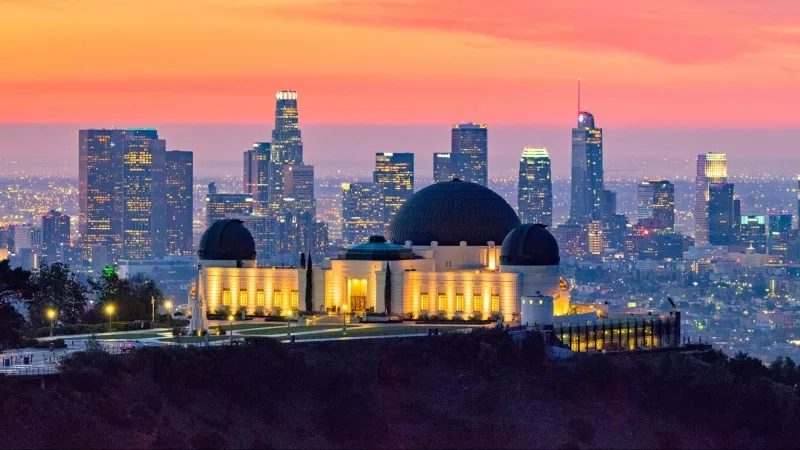
Not every entry on a venue list is a room you rent. The Los Angeles Tourism & Convention Board is the official destination organization for the City of Los Angeles, and it's one of the most useful planning partners you can loop in early. As destination experts, the team offers complimentary, personalized support on where to stay, meet, and host, from Hollywood and Downtown to the Valley, Westside, and Beach Cities. Think of it as a shortcut to the right venue rather than a venue itself, especially for citywide programs that need coordinated hotel blocks and local vendors.
- Destination scale: roughly 600 hotels, 60,000 guest rooms, and 300 special event venues
- Convention capacity: access to 867,000 sq. ft. of convention center space
- Planning metrics: average room rate around $190 and an 83.2% occupancy rate
- Access: LAX offers 886 daily flights from 175 cities, plus regional airports
- Support: complimentary, personalized help sourcing venues, hotels, and vendors
The Greek Theatre
Few outdoor venues carry the reputation of The Greek Theatre. Tucked into Griffith Park at 2700 North Vermont, this 1931 landmark is best known as a concert amphitheater, but it also hosts large-format corporate events, galas, and productions that benefit from a genuine sense of occasion. With 237,733 sq. ft. of total space and roughly 100,000 sq. ft. of it outdoors, it suits programs that want an open-air headline moment. Plan around a few specifics: event insurance is mandatory and union stagehand labor applies, which is standard for a venue of this profile.
- Total event space: 237,733 sq. ft. across 20 meeting rooms
- Outdoor space: 100,000 sq. ft.
- Capacity: up to 7,500 standing and 2,000 seated
- Room rental: roughly $5,000 to $40,000 depending on scope
- Amenities: on-site catering, alcohol allowed, staging area, and loading dock
- Good to know: about 10 miles from the airport with complimentary and paid parking
The GRAMMY Museum at L.A. Live
For events with a music or entertainment angle, The GRAMMY Museum at L.A. Live is hard to beat on theme. Set at 800 West Olympic Boulevard inside the L.A. LIVE district, it offers 24,675 sq. ft. across six flexible spaces, including galleries, a theater, and a rooftop terrace. The variety is the selling point: you can pair a rooftop reception with a seated program in the theater, then flow guests through gallery space. It works well for premieres, award dinners, receptions, and brand activations that want a cultural backdrop.
- Total event space: 24,675 sq. ft. across six rooms
- Rooftop Terrace: 8,100 sq. ft. for 200 to 400 guests
- Clive Davis Theater: 2,787 sq. ft. seating around 200
- Gallery spaces: 3rd and 4th floor galleries at roughly 6,059 and 5,549 sq. ft.
- Capacity: up to 400 standing and 200 seated overall
- Amenities: on-site catering, piano, staging, and loading dock; paid parking at $35 per day
Hotel Indigo Los Angeles Downtown
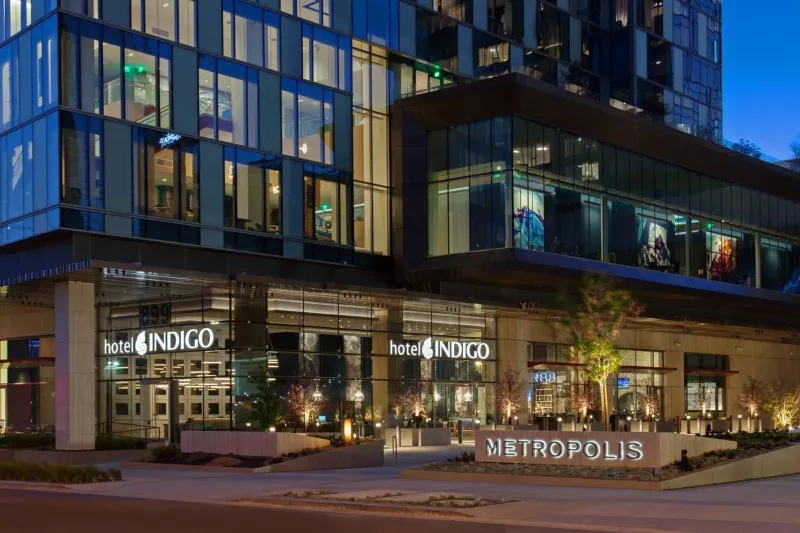
Hotel Indigo Los Angeles Downtown is a design-forward high-rise in the South Park section of downtown, within walking distance of the convention center and the L.A. LIVE entertainment district. It's a good fit for planners who want a boutique, neighborhood-branded hotel experience close to the city's main event corridor, with meeting and event space paired with on-site guest rooms. The location works especially well for smaller conferences, board meetings, and social receptions that benefit from a lively downtown setting and easy walkability.
- Downtown location near the LA Convention Center and L.A. LIVE
- Combines on-site guest rooms with flexible meeting and event space
- Boutique, design-led atmosphere suited to receptions and smaller programs
- Convenient base for citywide events using nearby convention space
JW Marriott Los Angeles L.A. LIVE
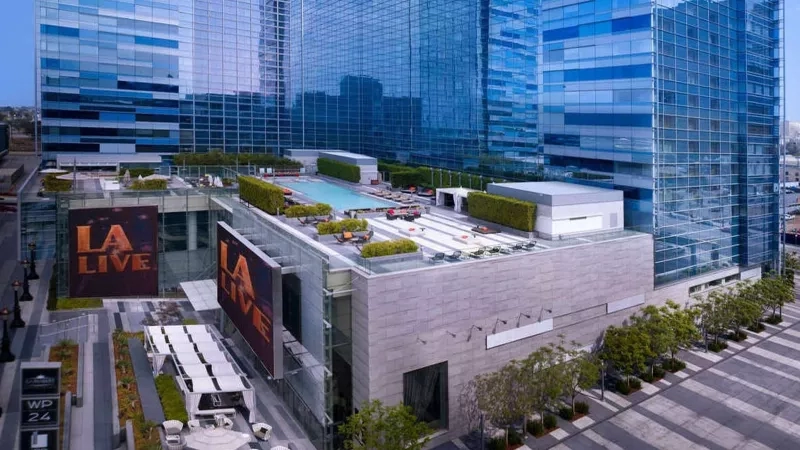
JW Marriott Los Angeles L.A. LIVE is one of the most convenient full-service host hotels for large downtown programs, sitting directly next to the Los Angeles Convention Center in the L.A. LIVE district. That adjacency is the headline: attendees can move between convention sessions, hotel rooms, and evening venues without transportation. It's a natural anchor property for conventions, association meetings, and corporate events that need substantial ballroom and breakout space alongside a large room block.
- Connected to the convention center and L.A. LIVE for citywide programs
- Full-service host hotel with guest rooms and event space under one roof
- Well suited to conventions, galas, and multi-day corporate meetings
- Walkable access to restaurants, theaters, and nightlife at L.A. LIVE
The Biltmore Los Angeles
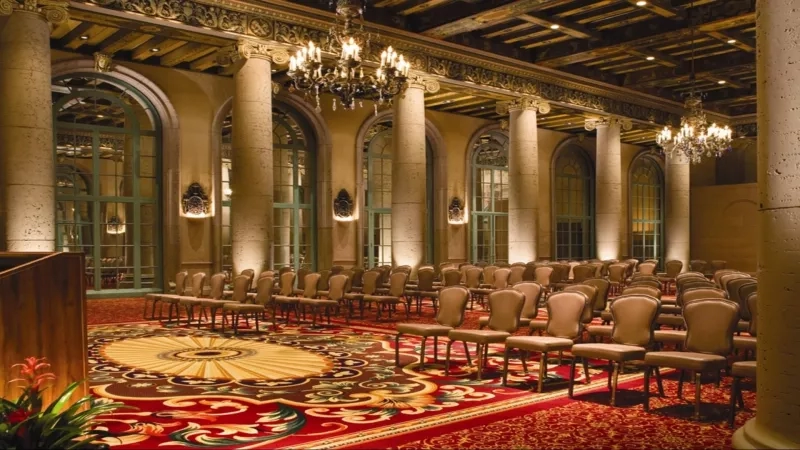
Historic grandeur is the draw at The Biltmore Los Angeles. Opened in 1923 and overlooking Pershing Square in the heart of downtown, it's long been one of the city's landmark hotels, known for ornate ballrooms and detailed architecture that give galas and formal events a period backdrop. Planners choose it when the program calls for elegance and a sense of history, from award dinners and weddings to executive receptions. The central downtown address also keeps it close to other major event spaces.
- Historic downtown landmark hotel dating to 1923
- Ornate ballrooms and architecture suited to galas and formal events
- Central location near Pershing Square and downtown attractions
- Combines guest rooms with classic event and meeting space
Tips for choosing the right venue
The strongest venue decisions come from what you learn after the brochure, not from it. Walk the space in person whenever you can, ideally at the same time of day your event will run, so you see the real light, noise, and flow rather than a staged photo. Ask pointed questions about what else is happening on your date, because a shared lobby or a louder event next door can quietly reshape the guest experience. Read the contract as carefully as the floor plan, and get clarity on who actually runs your event once you arrive. These are the checks that separate a venue that looks right from one that performs on show day.
1. See it in person before you commit.
A walkthrough reveals ceiling heights, sightlines, restroom access, and traffic flow that photos flatten, so visit or request a detailed virtual tour.
2. Ask what else is booked that day.
Simultaneous events can mean shared entrances, competing noise, or strained staff, so confirm whether you have the space to yourself.
3. Pressure-test connectivity and AV support.
For hybrid sessions and livestreams, ask about bandwidth, backup internet, and whether technicians are on hand throughout, not just for setup.
4. Nail down the catering model.
Some properties require in-house food and beverage, others allow outside caterers, and restaurants build it into the package, each of which changes cost and menu control.
5. Read the contract clauses that bite later.
Review cancellation, attrition, and force majeure terms before signing so a change in headcount or circumstances doesn't become an expensive surprise.
6. Confirm accessibility and inclusion needs.
Check step-free access, seating flexibility, and accommodations so every attendee can participate comfortably.
7. Know who runs your event day-of.
Identify your on-site contact and the staffing you'll have, since a responsive event team matters more than any single amenity when a quick fix is needed.
Final words
There's no single best event venue in Los Angeles, only the one that fits what your program is trying to accomplish. A product launch that lives or dies on atmosphere asks for something very different than a three-day association meeting with a full expo hall, and the city is deep enough to serve both without compromise. Let the purpose of the event lead, and the shortlist tends to narrow itself: the format points you toward a category, the guest experience points you toward a neighborhood, and your budget and timeline settle the rest.
Once you've got two or three real contenders, put them head to head rather than agonizing over a single favorite. Line them up on the details that actually decide the day, from usable space and guest rooms to the responsiveness of the team behind the venue, and the right answer usually becomes obvious.
FAQs
Los Angeles offers a wide range of venue types, mild weather that keeps outdoor spaces viable year-round, and a major international airport with connections from nearly anywhere. The city's cultural attractions also give attendees a strong reason to show up in person and extend their stay.
Start by defining your event format, realistic headcount, and the setup you need, such as theater seating, banquet rounds, or a standing reception. From there, set a budget that includes catering minimums, AV, parking, and union labor, not just the rental fee.
Downtown is ideal for convention-driven programs near the LA Convention Center and L.A. LIVE, while areas like Silver Lake, Hollywood, and the Beach Cities suit product launches, after-parties, or beachside receptions with a different atmosphere and audience feel.
The city offers roughly 300 special event venues spanning convention halls, landmark hotels, stadiums, museums, theaters, bars, and restaurants, giving planners viable options across nearly every format and headcount.
Yes, the organization provides complimentary, personalized support for sourcing venues, coordinating hotel blocks, and connecting with local vendors, which is especially useful for large or multi-property programs.
A walkthrough reveals ceiling heights, sightlines, restroom access, and traffic flow that photos and virtual tours often flatten, and visiting at the same time of day as your event shows you the real light, noise levels, and guest flow.
Beyond the rental fee, plan for catering minimums, AV equipment, parking, union stagehand labor at certain landmark venues, and guest room blocks to get an accurate picture of total spend.


