


A convention center can be popular with planners and still be the wrong fit for your event. A 5,000-person national trade show and a 400-person regional summit need very different rooms, and booking the wrong size costs you money, momentum, or both. That's why this guide to popular convention centers in the U.S. groups venues by size and venue type rather than forcing them into one ranking.
The timing works in your favor, too. Convention centers have gone from big box to big development, with dozens of facilities under construction or being renovated and expanded across the U.S. at an estimated combined cost of around $15 billion. For planners, that means more space, newer features, and more flexible layouts, including the smaller networking spaces many groups now want alongside traditional exhibit halls.
Exhibit space across these venues ranges from about 76,000 square feet to more than 2 million square feet, so there's a real fit for nearly every event size. Below, you'll find 15 standout convention centers sorted into four practical tiers, each with a clear sense of the events it serves best.
Quick answer: Popular US convention centers at a glance
The top convention centers in the US range from mega venues built for national trade shows, such as the Las Vegas Convention Center and the Orange County Convention Center in Orlando, to large metro hubs like Phoenix and San Diego, right-sized regional centers like Denver and Columbus, and specialty spaces like Gaylord National. The right choice comes down to your attendee count, exhibit needs, and destination.
Convention center comparison table
Venue | City | Total meeting space | Exhibit space | Meeting rooms | Best for |
|---|---|---|---|---|---|
| Las Vegas Convention Center | Las Vegas, NV | 2,934,153 sq. ft. | 2,454,132 sq. ft. | 225 | National mega trade shows |
| Orange County Convention Center | Orlando, FL | 479,190 sq ft | 2,055,222 sq ft | 82 | High-volume citywide events |
| Anaheim Convention Center | Anaheim, CA | 1,150,192 sq ft | 1,013,000 sq ft | 99 | West Coast trade shows |
| Walter E. Washington Convention Center | Washington, DC | 2,300,000 sq ft | 703,000 sq ft | 77 | National associations |
| Phoenix Convention Center | Phoenix, AZ | 900,000 sq ft | 502,500 sq ft | 101 | Big-city conferences |
| Los Angeles Convention Center | Los Angeles, CA | 867,000 sq ft | 720,000 sq ft | 64 | Large entertainment-adjacent events |
| San Diego Convention Center | San Diego, CA | 260,000 sq ft | 615,701 sq ft | 129 | Waterfront conventions |
| Miami Beach Convention Center | Miami Beach, FL | 500,000 sq ft | 500,000 sq ft | 84 | Oceanfront large events |
| Colorado Convention Center | Denver, CO | 270,000 sq ft | 584,000 sq ft | 68 | Central-US regional events |
| Greater Columbus Convention Center | Columbus, OH | 242,000 sq ft | 373,000 sq ft | 98 | Midwest mid-size events |
| Fort Worth Convention Center | Fort Worth, TX | 253,226 sq ft | 182,613 sq ft | 38 | Regional Texas events |
| Thomas M. Menino Convention and Exhibition Center | Boston, MA | 210,000 sq ft | 516,000 sq ft | 132 | Tech and life sciences events |
| Gaylord National Resort and Convention Center | National Harbor, MD | 543,889 sq ft | 110,000 sq ft | 93 | All-in-one resort events |
| Long Beach Convention and Entertainment Center | Long Beach, CA | 400,000 sq ft | 76,000 sq ft | 34 | Waterfront, entertainment-style events |
| DCU Center | Worcester, MA | 129,464 sq ft | 110,000 sq ft | 25 | Regional arena-style events |
How to match a convention center to your event size
Square footage gets the headlines, but on its own, it won't tell you whether a convention center is right for your event. Two venues with similar totals can perform very differently depending on how their space is split between exhibit halls, ballrooms, and breakout rooms. What surrounds the building matters just as much as the hotel rooms and airport access. Start with your attendee count to narrow the tier, then use the factors below to find the right building within it. Checking these early saves you from paying for space you don't need or squeezing into rooms that can't hold your group.
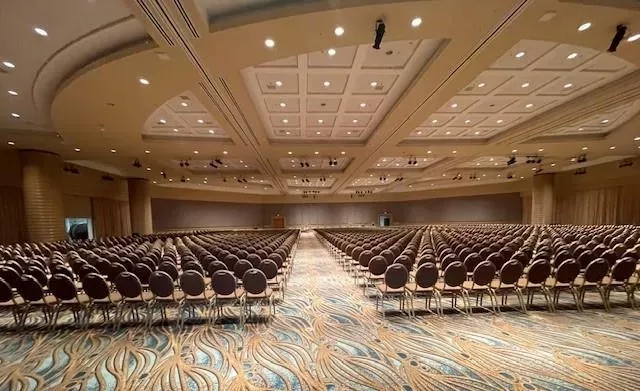
- General session size: Make sure one room can seat your full group with space for staging and AV. The Walter E. Washington Convention Center lists seating for 4,480, while Long Beach lists 1,400.
- Exhibit-heavy or session-heavy: Trade shows need large, connected halls and loading access, while conferences need many rooms close together. Boston's Thomas M. Menino Convention and Exhibition Center has 132 meeting rooms, and San Diego Convention Center has 129.
- Flexible and networking space: Pollstar reports a growing need for smaller networking spaces alongside traditional exhibit halls, so ask how quickly each venue can reset its rooms.
- Hotel package: Look for rooms within walking distance and a nearby headquarters hotel. The Las Vegas Convention Center has more than 10,000 guest rooms.
With those factors in mind, let's start at the top of the size range with the mega convention centers that anchor the country's largest trade shows.
Mega convention centers built for national trade shows
These venues cover a million square feet and anchor the largest citywide events in the country. If your show fills exhibit halls and books thousands of hotel rooms, start here.
Las Vegas Convention Center
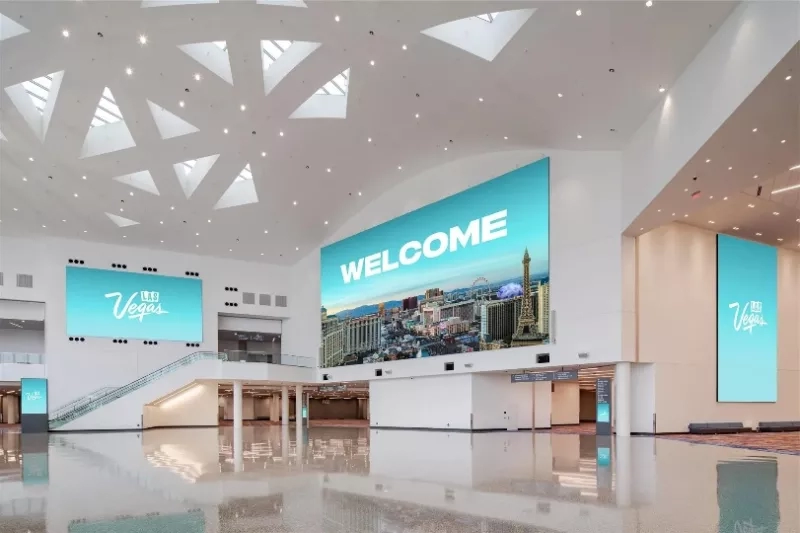
No US convention list is complete without Las Vegas, the benchmark for scale against which other venues are measured. The center sits at the heart of a city built for large-format events, with unmatched hotel inventory, direct transit links, and an airport minutes away. Its West Hall expansion added modern exhibit space and a distinctive design that reset expectations for what a mega venue can be. For citywide trade shows that need room to grow year after year, few properties compete on raw capacity. It remains the default choice for the biggest national and international shows.
- One of the largest exhibition facilities in North America
- Connected to the wider Las Vegas resort corridor by an automated transit link
- Massive contiguous exhibit halls suited to citywide trade shows
- Minutes from Harry Reid International Airport, with deep hotel inventory nearby
Orange County Convention Center (Orlando)
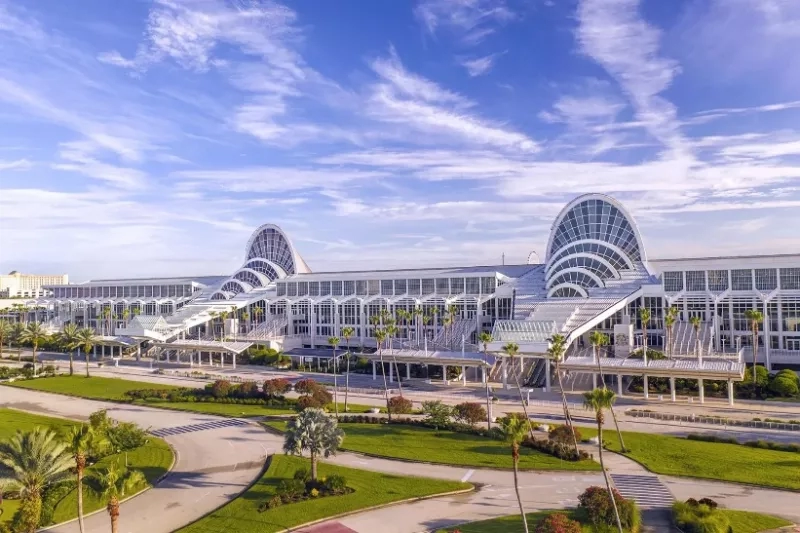
Orlando’s Orange County Convention Center is one of the busiest venues in the country, and its exhibit space is the largest on this list. The property hosts more than 200 events a year and drives an estimated $3.9 billion in annual economic impact for the region. A 2017 renovation modernized its already vast footprint, and its location near Orlando’s airport, hotels, and attractions makes attendee logistics straightforward. For organizers who need a huge floor plate plus an easy destination sell, OCCC is hard to beat. It handles the largest medical, technology, and consumer shows with room to spare.
- 2,055,222 square feet of exhibit space, the most on this list
- 479,190 square feet of meeting space across 82 meeting rooms
- Hosts 200-plus events a year with roughly $3.9 billion in annual economic impact
- Close to Orlando International Airport and major hotel clusters
Anaheim Convention Center
Anaheim is the largest exhibition facility on the West Coast, and a 2017 expansion pushed its total footprint past a million square feet. The center pairs a serious scale with a resort-town setting next to the Disneyland area, which gives planners a built-in attendee draw. LEED Gold certification and a long list of industry awards reflect a property that has kept modernizing rather than resting on its size. For West Coast trade shows that want capacity without leaving California, it’s a natural anchor. Flexible halls make it work for both exhibition-heavy and meeting-heavy formats.
- 1,150,192 square feet of meeting space and 1,013,000 square feet of exhibit space
- 99 meeting rooms with flexible configurations
- LEED Gold certified, with a strong record of industry recognition
- Adjacent to the Disneyland resort area and Anaheim’s hotel base
Walter E. Washington Convention Center (Washington, DC)
The Walter E. Washington Convention Center puts a major exhibition facility in the center of the nation’s capital, which is exactly why national associations and government-adjacent events gravitate to it. Opened in 2003, the roughly 2.3-million-square-foot facility connects to the Metro and sits within walking distance of a large downtown hotel package. That transit access matters for attendees flying in from across the country and moving without a car. Its ballroom and exhibit scale support everything from policy summits to large trade expos. For Washington, DC based programs, the location does a lot of the selling.
- Roughly 2.3 million square feet of total facility space
- 703,000 square feet of exhibit space across 77 meeting rooms
- Metro-connected in downtown Washington, DC
- Walkable to a deep downtown hotel package
Large metro workhorses in major cities
These centers sit in the mid-large range and thrive in big cities with strong air access and hotel packages. They’re reliable hosts for national association meetings and large conferences that don’t need a million square feet.
Phoenix Convention Center
Phoenix has quietly become one of the strongest convention hosts in the Southwest, earning a place among the top-tier US venues and an AAAA rating for its facilities. Built out in 2008, it offers a large, modern footprint in a walkable downtown lined with hotels, restaurants, and light-rail access. The dry climate and easy airport connections make it a dependable draw for winter and shoulder-season events. Planners consistently praise its service and layout, which is often the deciding factor between similarly sized cities. It’s a smart pick for conferences that want scale plus a manageable downtown.
- 900,000 square feet of meeting space and 502,500 square feet of exhibit space
- 101 meeting rooms
- Recognized among the top 25 US venues, with an AAAA rating
- Light-rail access and a walkable downtown entertainment district
Los Angeles Convention Center
The Los Angeles Convention Center anchors the LA Live entertainment district downtown, which gives events an instant hook for attendees. A LEED Gold facility opened in 1971, and it offers substantial exhibit and meeting space in one of the country’s largest media markets. Its location near arenas, theaters, hotels, and dining makes evening programming easy to plan. For large events that benefit from an entertainment backdrop and West Coast reach, it’s a proven host. Planned modernization efforts aim to keep it competitive with newer venues in Los Angeles.
- 867,000 square feet of meeting space and 720,000 square feet of exhibit space
- 64 meeting rooms
- LEED Gold certified
- Steps from the LA Live entertainment district and downtown hotels
San Diego Convention Center
This Convention Center in San Diego is one of the most requested waterfront venues in the country, and for good reason. It sits directly on the bay, three miles from the airport, and within walking distance of the Gaslamp Quarter’s hotels and nightlife. The center offers more than 600,000 square feet of exhibit space and an unusually high count of 129 meeting rooms, which suits events with many concurrent sessions. Mild weather year-round makes it a favorite for large conventions that want an outdoor element. For attendee experience, few big-city venues match the setting.
- 615,701 square feet of exhibit space and 260,000 square feet of meeting space
- 129 meeting rooms, one of the highest counts on this list
- Bayfront location, three miles from San Diego International Airport
- Walkable to Gaslamp Quarter hotels and dining
Miami Beach Convention Center
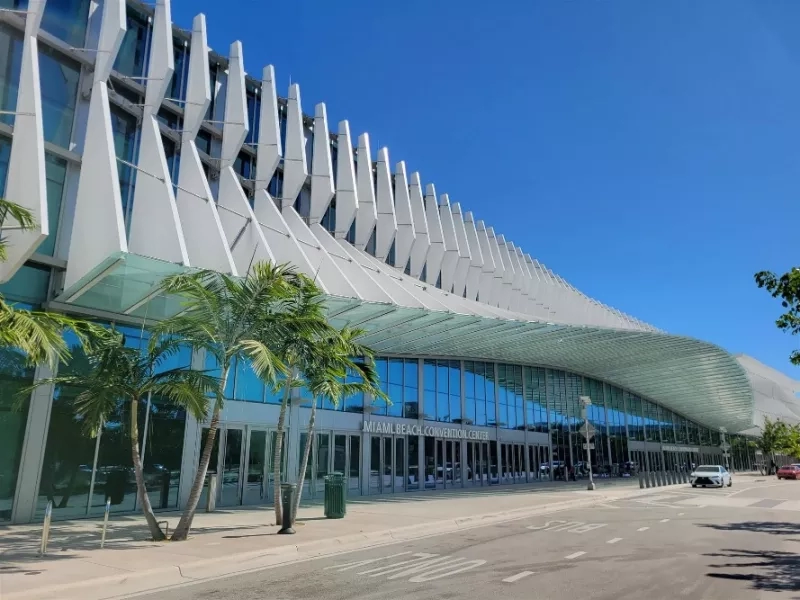
A $640 million renovation completed in 2020 reinvented the Miami Beach Convention Center as a modern oceanfront campus. This Miami property now offers 500,000 square feet of meeting and exhibit space, a rooftop, and flexible outdoor areas, all within walking distance of the beach and South Beach hotels. LEED certification and recent industry recognition underscore how far the venue has come. For large events that want warm weather and a destination that sells itself, Miami Beach delivers.
- 500,000 square feet of meeting space and 500,000 square feet of exhibit space
- 84 meeting rooms, plus rooftop and outdoor space
- $640 million renovation completed in 2020
- LEED certified, in a walkable South Beach location
Regional and mid-size standouts
When a mega venue would swallow your event, these right-sized centers offer strong facilities, central access, and destinations that keep attendees engaged. They’re ideal for regional programs and mid-size conferences.
Colorado Convention Center (Denver)
The Colorado Convention Center in Denver got a major lift from a 2023 expansion that added rooftop and terrace space with mountain views. Its central US location makes it one of the easiest cities to reach from either coast, which is a real advantage for national-regional hybrid events. The center pairs solid exhibit and meeting capacity with sustainability certification and a walkable downtown full of hotels and restaurants. For associations that rotate through the middle of the country, it’s a dependable, modern choice. The recent renovation keeps it feeling current next to newer venues.
- 584,000 square feet of exhibit space and 270,000 square feet of meeting space
- 68 meeting rooms
- 2023 expansion added rooftop and terrace space
- Central US location with a walkable downtown Denver setting
Greater Columbus Convention Center
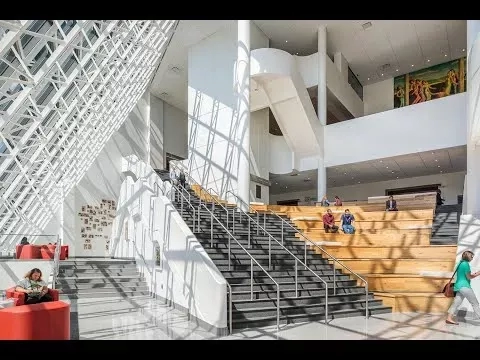
Managed by ASM Global, the Greater Columbus Convention Center has built a reputation for service and design in the Midwest. A 2017 renovation refreshed the property, which sits beside the walkable Short North Arts District and its hotels and restaurants. Columbus draws heavily from the region’s large drive market, making it cost-effective for attendees across the Midwest. The center offers a comfortable mid-size footprint that suits state associations, regional trade shows, and mid-cap conferences. Recognition for facility quality reinforces its standing among central-US venues.
- 373,000 square feet of exhibit space and 242,000 square feet of meeting space
- 98 meeting rooms
- ASM Global-managed, renovated in 2017
- Walkable to the Short North district, with strong Midwest drive-market reach
Fort Worth Convention Center
Fort Worth offers a mid-size Texas option with easy access and a genuinely walkable entertainment district in Sundance Square. The center provides a comfortable footprint for regional events and mid-size conventions without the overhead of a mega venue. Its proximity to Dallas Fort Worth International Airport keeps travel simple for attendees flying in from across the country. The surrounding downtown gives planners built-in dining and nightlife within a short walk. For programs rooted in the Southwest, it’s a practical, budget-aware choice.
- 253,226 square feet of meeting space and 182,613 square feet of exhibit space
- 38 meeting rooms
- Walkable to Sundance Square, with easy DFW airport access
- Well-suited to regional and mid-size events
Thomas M. Menino Convention and Exhibition Center (Boston)
Menino Center in Boston, known to many as the BCEC, claims the shortest airport transfer of any major US convention venue at about 8 minutes from Logan. That access is a serious draw for national attendees who value time. Opened in 2004, the modern facility sits in the Seaport District, surrounded by hotels, restaurants, and waterfront space. Its high meeting-room count suits events with dense session programming, and the city’s academic and biotech pull makes it a magnet for tech and life sciences gatherings. For Northeast programs, it combines convenience with a current, well-run facility.
- 516,000 square feet of exhibit space and 210,000 square feet of meeting space
- 132 meeting rooms, the highest count on this list
- About 8 minutes from Boston Logan International Airport
- Seaport District location, strong for tech and life-sciences events
Distinctive and specialty venues
These picks win on format rather than raw square footage. Judge them on fit, not scale, because each solves a specific kind of event challenge.
Gaylord National Resort and Convention Center (National Harbor)
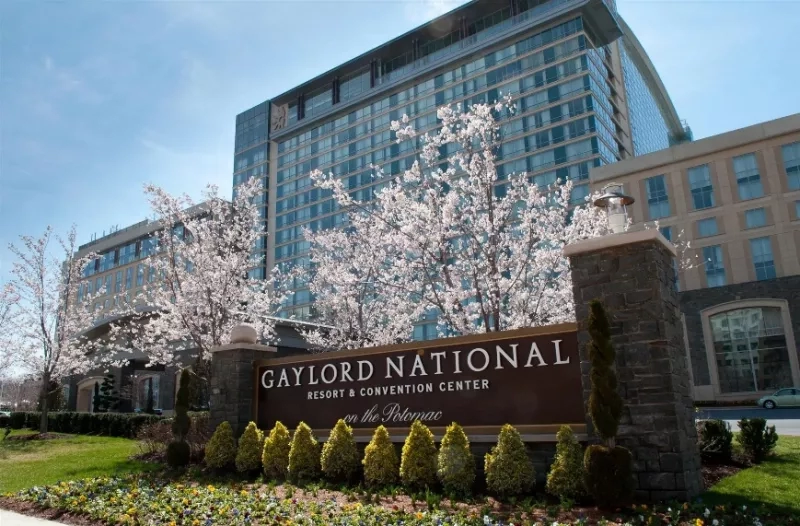
Gaylord National is the best all-in-one option on this list, pairing a large convention footprint with a full resort under one roof. Attendees sleep, meet, dine, and network without ever leaving the property, which simplifies logistics for multi-day programs. The signature atrium and Potomac waterfront setting give events a sense of place, and the DC-area location keeps it accessible. With nearly 2,000 guest rooms on site, room-block management gets far easier than at a standalone center. It’s categorized as a resort, so treat it as a self-contained event experience rather than a pure exhibition hall.
- Roughly 543,889 square feet of meeting space and 110,000 square feet of exhibit space
- 93 meeting rooms and 1,996 on-site guest rooms
- All-in-one resort with on-site dining, lodging, and an atrium setting
- Waterfront National Harbor location near Washington, DC
Long Beach Convention and Entertainment Center
Long Beach is the best pick for events that want waterfront personality over sheer scale. The bayfront campus combines convention space with an adjacent arena and performing-arts venues, so organizers can stage general sessions, exhibits, and entertainment steps apart. It’s walkable to hotels and dining, with easy Southern California access. The setting suits consumer shows, association meetings, and creative events that benefit from an open, coastal feel. For a distinctive alternative to the region’s mega venues, it stands out. Use the full center profile rather than the meeting-space-only listing when you source it.
- 400,000 square feet of meeting space and 76,000 square feet of exhibit space
- 34 meeting rooms
- Bayfront campus with an adjacent arena and performing-arts spaces
- Walkable to hotels, with easy Southern California access
DCU Center (Worcester)
The DCU Center is the best arena-style, multipurpose option for regional New England events that pair an exhibit floor with an arena bowl. Located in central Massachusetts, it draws from a wide drive market and works well for consumer shows, regional conventions, and events that need flexible arena seating. It’s categorized as an arena and stadium rather than a traditional convention center, so plan around that format instead of comparing it to a mega hall. For organizers who want arena energy and exhibition space in one building, it fills a genuine niche. Treat it as a specialty regional venue.
- 129,464 square feet of meeting space and 110,000 square feet of exhibit space
- 25 meeting rooms, with arena and exhibition flexibility
- Central Massachusetts location with a broad regional drive market
- Best for regional consumer shows and arena-style events
Tips for booking a convention center for your event
Once you have narrowed your list to a few centers, how you work with each venue affects the price and terms you ultimately secure. The tips below cover the conversations and checks that planners often leave too late. Handle them early, and you'll get more accurate quotes, fewer surprise costs, and a smoother path to a contract.
- Share your budget and goals in the first conversation: Many convention centers base rental rates on food-and-beverage minimums, so a venue can't quote accurately without knowing your budget. If the rental price is out of reach, a sales manager may know of discounts, hotel rebates, or CVB funding that can offset the cost.
- Bring in the local CVB early: Convention and visitors bureaus are usually free for event planners to use. They can also help negotiate contracts, get permits, and find incentives. They're a good source of local advice before you commit to a city.
- Ask which services are exclusive to the venue: Some centers require you to use their in-house catering or IT. Find out what's included and where outside vendors are allowed before you budget for AV, catering, or internet.
- Send your technical requirements before you ask for quotes: share your power, rigging, AV, and connectivity needs during the bidding process so the venue can give you an accurate price. A vague request leads to a vague quote and costly changes later.
- Check rooms with 3D floor plans before you book site visits: Venue profiles on the Cvent Supplier Network include setup charts and interactive 3D floor plans. Use them to rule out rooms that won't work, so you only visit your top choices, which also saves money on travel.
- Ask who else will be in the building: Cities increasingly book convention centers for several meetings at the same time. Ask which other events overlap with your dates, including move-in and move-out days. Shared lobbies, loading docks, and food service can affect your schedule and attendees' experience of the event.
Final words
The main lesson from this list of popular convention centers in the U.S. is simple: pick the venue tier that fits your event first, then choose the city. If you're planning a national trade show that fills exhibit halls, start with the mega centers in Las Vegas, Orlando, or Anaheim. For a big-city association meeting, the large metro workhorses in Phoenix, Los Angeles, San Diego, and Miami Beach offer scale plus a destination that helps drive attendance.
Regional and mid-size programs often do better in Denver, Columbus, Fort Worth, or Boston, where the space fits the group without swallowing it. And if your program needs something distinctive, an all-in-one resort or an arena-style venue may be the smartest choice. Wherever you land, confirm current capacities, availability, and pricing directly with each property before you commit.
Ready to compare real venues side by side? Search meeting and exhibit space, capacities, and availability for every city on this list, and shortlist the centers that fit your event on the Cvent Supplier Network.


