


Every year, Cvent's Global Planner Sourcing Report asks meeting and event professionals how they’re really planning, sourcing, and measuring the impact of their events. In the2026 edition, we surveyed 1,650 planners globally to see how their priorities are shifting – and we found that the industry is entering a more intentional era.
Planners are shifting their focus from event volume to event value, prioritizing engagement, experience, and efficiency in how they design and source events.
At the same time, rising costs, tighter budgets, and rapidly evolving technology are reshaping how sourcing decisions are made.
Here’s what the latest data reveals about how planners are adapting and what it means for venue sourcing in 2026.
Key takeaways
- Attendee engagement is now the leading success metric, with 63% of planners citing it as their primary KPI.
- Financial pressure is intensifying: 72% expect event costs to rise, while 35% say staying within budget is their biggest concern.
- Unique venues continue to gain traction, with 48% of planners sourcing non-hotel spaces to deliver more engaging and flexible event experiences.
- Structured sourcing processes are delivering measurable ROI, with 97% reporting time and cost savings.
1. Attendee engagement defines event success
When asked about top success metrics, 63% of planners cite attendee engagement, marking a clear shift away from cost as the dominant KPI.
This shift signals a fundamental recalibration of priorities. For years, organizations have evaluated their event programs through the lens of scale: the number of meetings held, total attendance, or overall spend managed. In 2026, that equation has changed.
Growth expectations have softened, yet demand for impact has intensified. Planners are under pressure to demonstrate that each event delivers tangible business outcomes, whether that means stronger relationships, higher-quality networking, improved knowledge retention, or measurable shifts in brand perception.
This engagement-first mindset also explains the growing emphasis on sustainability, accessibility, and DEI-focused local experiences.
Accessibility and sustainability are now embedded priorities, with 74% of planners saying they are prioritizing accessibility more than in previous years and 78% saying venue sustainability efforts are an important factor in sourcing decisions.

These factors are integral to designing events that resonate with modern audiences. In practical terms, this means sourcing decisions must align not just with budgets, but with experience design.
Venues and suppliers are therefore evaluated on their ability to enable interaction, flexibility, and immersion, not simply on room rates or availability.
2. Unique spaces are in high demand

Almost half (48%) of planners are sourcing non-hotel venues such as restaurants, art galleries, and other special-event spaces - a dramatic increase over recent years. This signals a change in how planners define value through space and a strategic response to engagement-driven goals.
The top booking drivers for unique venues are:
- Flexibility (41%)
- Attendee experience (35%)
- Cost (34%)
Restaurants remain the most popular non-hotel option (45%), followed by bars (23%) and wineries (19%), reflecting demand for culturally integrated and experiential settings.
These spaces often allow for:
- More creative layouts
- Stronger thematic alignment
- Memorable atmospheres that support immersive programming.
Importantly, unique venues are not always more expensive. In some cases, alternative spaces offer competitive pricing structures or built-in aesthetic value that reduces décor spend. In others, their flexibility enables you to maximize space and avoid costly add-ons.
As planners broaden their sourcing strategies, discovery and comparison become more complex. Tools like the Cvent Supplier Network (CSN) support this shift by helping you to identify diverse, vetted venues while maintaining visibility into specifications, amenities, and response timelines.
3. Technology and AI adoption are high, but friction remains
Technology use among planners is almost universal. The vast majority use online RFP tools, and 75% already use AI for venue searches.
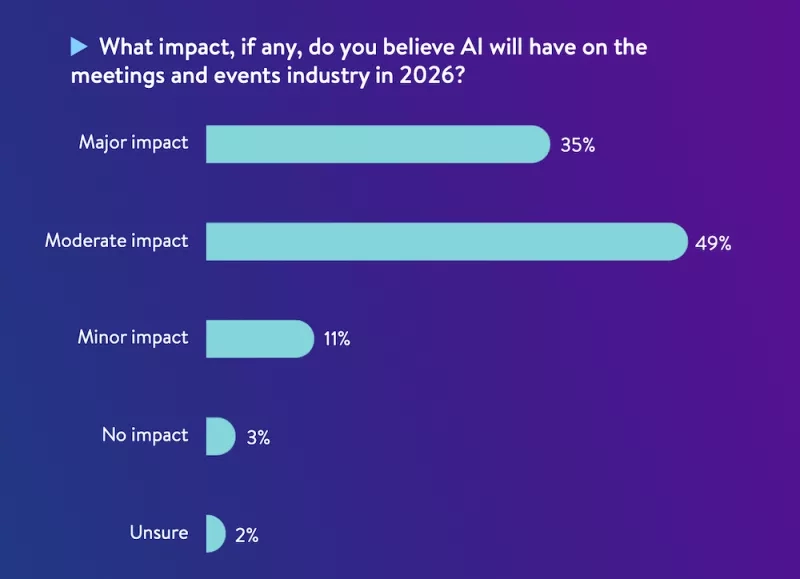
In fact, 84% believe AI will have a moderate-to-major impact on the meetings and events industry in 2026, and 61% expect to increase their use of AI in the year ahead to:
- Search and select venues
- Create and optimize RFPs
- Compare bids and proposals
- Analyze attendee data for a better venue fit
- Automate communication with venues
- Predict trends and attendance
Yet, despite this widespread intent and adoption, nearly one-third of planners say their sourcing technology either hinders their workflow or adds no measurable value.
At the same time, 58% spend up to five hours using technology to source each event. This paradox reveals that adoption is not automatically translated into efficiency.
AI should help you spend less time searching and more time planning by allowing you to find, compare and book venues in record time.
Learn how to get more from AI in your events with CventIQ.
3. Speed and transparency are the new standard

The RFP remains central to venue sourcing, but expectations for responsiveness and clarity are rising, and for good reason.
Today’s planners often manage multiple events simultaneously while working within tighter timelines and under budget scrutiny. In that environment, slow or incomplete responses can delay decisions, compress planning timelines, and increase the risk of missing preferred venues.
The data reflects this growing urgency. For events with up to 50 attendees, 63% of planners expect a response within four business days, while 55% expect the same turnaround for events with 51–100 attendees.
Speed, however, is only part of the equation. You also need clear information to quickly evaluate options. Meeting room specifications, images, videos, and floor plans are among the most influential factors when deciding whether to move forward with a venue.
When this information is missing or difficult to access, the sourcing process slows down. In fact, 25% of planners say researching venue specifications is the most challenging stage of sourcing, while 24% cite delays in receiving responses as a key obstacle.
For planners working against tight deadlines, delays limit effective venue comparison, increase the likelihood of last-minute compromises, and ultimately affect the attendee experience.
This is why transparency and responsiveness have become critical differentiators. Venues that provide clear information and timely responses enable you to make faster, more confident decisions.
4. A clear sourcing process saves planners time and money
One of the clearest insights from the report is that having a defined sourcing process really works.
An overwhelming 97% of planners say that following a structured RFP and sourcing process saves both time and money. Adoption is already widespread, with 88% saying they follow a defined process for at least some of their meetings.
The savings are significant:
- 42% report cost reductions of 10–30%
- 40% report time savings in the same range
In a year when 72% of planners expect event costs to rise, those efficiencies can make a real difference.
A clear sourcing process helps you compare venues more easily, keep track of information, and avoid duplicating work for every event. Instead of chasing responses or rebuilding spreadsheets, you can evaluate options faster and make more confident decisions.
Most importantly, saving time on sourcing mechanics frees you up to focus on what matters most: designing better programs and creating stronger attendee experiences.
What does all this mean for 2026?

Event success is being redefined.
Planners are no longer measured by the number of meetings they deliver, but by the quality of the experiences they create. With 63% now citing attendee engagement as the primary success metric, the focus is increasingly on designing events that foster connection, learning, and memorable experiences.
At the same time, planners are navigating rising financial pressure. With 72% expecting event costs to increase and 35% saying staying within budget is their biggest concern, the challenge is balancing creativity with cost discipline.
This means sourcing decisions must be more strategic: choosing venues, partners, and technologies that enhance the attendee experience while still delivering value.
Technology will play an increasingly important role in helping you manage that balance. From AI-assisted venue sourcing to digital RFP tools, the right platforms can help you compare options faster, streamline communication with venues, and make more informed decisions. But as the report shows, adoption alone isn’t enough; you rightly expect these tools to deliver real efficiency.
The planners who succeed in 2026 will be those who combine strong processes with creative thinking. By adopting clear sourcing workflows, prioritizing engagement-driven venues, and using technology strategically, you can navigate rising complexity while continuing to deliver impactful events.
To discover more insights, download the 2026 Cvent Global Planner Sourcing Report.
Venue sourcing trends: FAQs
What should I be prioritizing when sourcing venues in 2026?
Prioritize venues that support attendee engagement above all else. It's now the leading success metric, with 63% of planners citing it as their primary KPI. That means evaluating venues on their ability to support interaction, flexibility, and memorable experiences, not just room rates and availability. Accessibility and sustainability are also worth building into your sourcing criteria early, with 74% of planners making accessibility a higher priority than in previous years.
What types of venues are other planners sourcing?
More planners are moving beyond hotels, with almost half (48%) now sourcing non-hotel venues such as restaurants, art galleries, and special event spaces. Restaurants are the most popular choice (45%), followed by bars (23%) and wineries (19%). The top reasons planners choose these spaces are flexibility (41%), attendee experience (35%), and cost (34%) — and unique venues aren't always more expensive than traditional hotel spaces.
How quickly should I expect a venue to respond to my RFP?
Response time expectations are high. For events with up to 50 attendees, 63% of planners expect a response within four business days. The same turnaround is expected by 55% of planners for events with 51–100 attendees. Slow or incomplete responses can delay decisions and compress planning timelines.
What venue information do I need to make a confident sourcing decision?
Meeting room specifications, images, videos, and floor plans are among the most influential factors. When this information is missing or hard to access, the sourcing process slows down — 25% of planners say researching venue specifications is the most challenging stage of sourcing.
How should I be using AI in my venue sourcing process?
Use AI to handle the time-intensive parts of sourcing — searching and selecting venues, creating and optimizing RFPs, comparing bids, and automating venue communication. Most planners are already doing this, with 75% using AI for venue searches
How much time and money can a structured sourcing process save me?
A structured sourcing process can reduce both time and costs by 10–30%. In fact, 97% of planners say following a structured RFP and sourcing process saves both time and money, with 42% reporting cost reductions and 40% reporting time savings in that range. With event costs expected to rise in 2026, having a clear process in place is one of the most practical ways to protect your budget.


